
- kasipalayamcetp@gmail.com
- +91 98940 42128
Kasipalayam Common Effluent Treatment Plant Pvt. Ltd.,
Products & Recovery
Glauber Salt
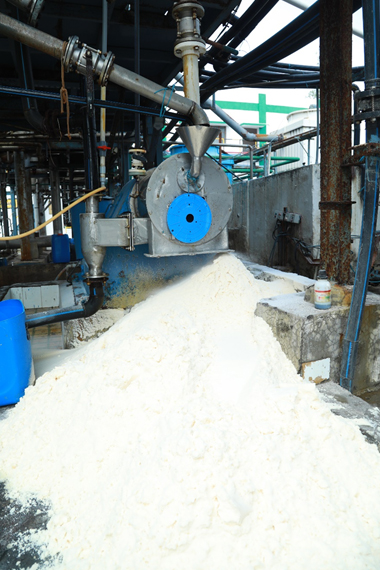
The reject from the nanofiltration system is fed into the MEE to achieve further concentration. approximately 130 g/L to 350 g/L, making it suitable for further processing in the adiabatic chiller.
In the adiabatic chiller, salts are crystallized at low temperatures. The crystallized salts are then sent to a centrifuge, where Glauber's salt is separated, collected in bags, and recycled back to member units.
Glauber's Salt Parameters:
| S.No | Parameters | Values |
|---|---|---|
| 1 | pH | 7.1 |
| 2 | Moisture | 43 % |
| 3 | Total Dissolved Solids | 42300 mg/L |
| 4 | Total Hardness as CaCO3 | 0.04 % |
| 5 | Total Alkalinity as CaCO3 | 20 mg/L |
| 6 | Bicarbonate Alkalinity as CaCO3 | 24 mg/L |
| 7 | Sodium Chloride as NaCl- | 408 (0.9%) |
| 8 | Sodium Sulphate as Na2SO4 | 41891 (99.0%) |
Sodium Chloride Salt
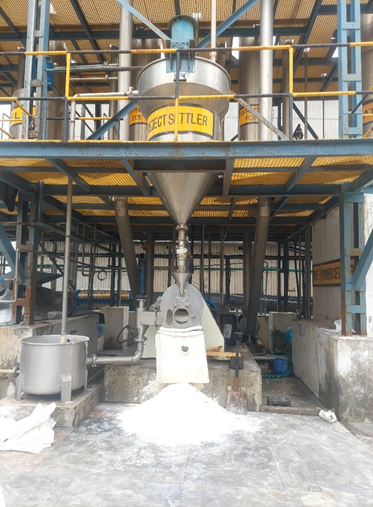
The Chloride Concentration RO(CCRO) reject, containing approximately 80 g/L sodium chloride, is treated in the chloride MEE system. Here, water is evaporated to produce high-purity sodium chloride crystals. A pusher centrifuge is used to ensure maximum purity of the recovered salt. The quality parameters of the recovered chloride salt are presented in the subsequent table:
Sodium Chloride Salt Parameters:
| S.No | Parameters | Values |
|---|---|---|
| 1 | pH | 9.4 |
| 2 | Total Dissolved Solids | 97500 mg/L |
| 3 | Total Hardness as CaCO3 | 0.04 % |
| 4 | Total Alkalinity as CaCO3 | 410 mg/L |
| 5 | Bicarbonate Alkalinity as CaCO3 | 500 mg/L |
| 6 | Sodium Chloride as NaCl- | 96979 (99.4%) |
| 7 | Sodium Sulphate as Na2SO4 | 520 (0.5%) |
Anhydrous Salt
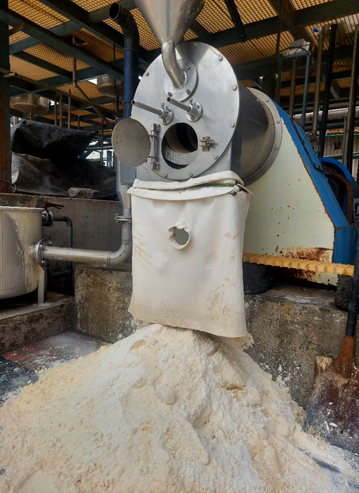
Mother liquor from the chiller centrifuge is further treated in a reactor clarifier along with softener regeneration wastewater. In the reactor clarifier, impurities such as hardness and colour are reduced through chemical dosing. The clarified mother liquor is then fed to a forced circulation evaporator for further concentration, followed by centrifugation to recover anhydrous salt, which predominantly consists of sodium sulphate.
Anhydrous Salt Parameters:
| S.No | Parameters | Values |
|---|---|---|
| 1 | pH | 9.3 |
| 2 | Moisture | 15 % |
| 3 | Total Dissolved Solids | 94500 mg/L |
| 4 | Total Hardness as CaCO3 | 0.3 % |
| 5 | Total Alkalinity as CaCO3 | 380 mg/L |
| 6 | Bicarbonate Alkalinity as CaCO3 | 463 mg/L |
| 7 | Sodium Chloride as NaCl- | 1097 (1.16%) |
| 8 | Sodium Sulphate as Na2SO4 | 93402 (98.8%) |
Brine
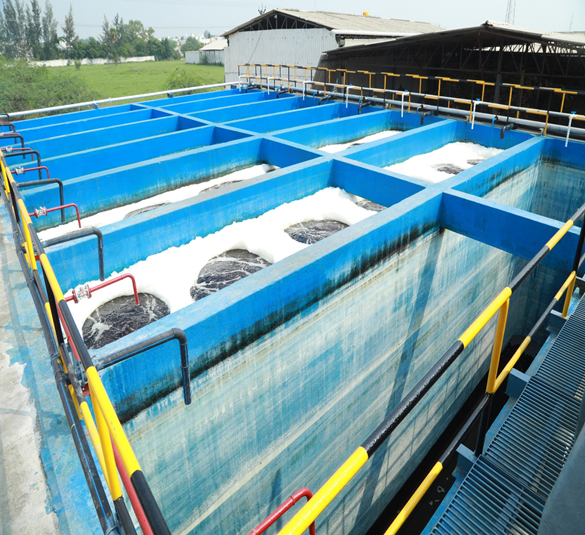
NF reject water, with a concentration of about 130-140 gpl, is fed to the brine treatment tank, where the colour and alkalinity are reduced using chlorine gas and sulphuric acid. After the removal of free chlorine, the treated brine is pumped to the member units for reuse. The utilisation of this brine significantly reduces the operating cost of the CETP and minimizes the need for fresh salt procurement. The quality parameters of the Brine solution are presented in the subsequent table.
Brine Parameters:
| S.No | Parameters | Values |
|---|---|---|
| 1 | pH | 5.0 - 5.6 |
| 2 | Total Dissolved Solids | 125 - 135 gpl |
| 3 | Total Hardness as CaCO3 | < 200 mg/L |
| 4 | Total Alkalinity as CaCO3 | < 40 mg/L |
| 5 | Bicarbonate Alkalinity as CaCO3 | < 50 mg/L |
| 6 | Chloride as Cl- | 8 - 12 gpl |
| 7 | Sodium Chloride as NaCl- | 15 - 20 gpl |
| 8 | Sodium Sulphate as Na2SO4 | 110 - 120 gpl |
| 9 | Free Residual Chlorine (FRC) | Nil |
| 10 | Colour | < 2500 Pt.Co |
| 11 | Specific Gravity | 1.11 - 1.13 |
Recovered RO permeate and MEE condensate water
RO permeate is recovered from the 1st stage to the 6th stage of the RO system, including the CCRO unit. Evaporator condensate is collected from the sulphate MEE, chloride MEE, and the forced circulation evaporator. The quality parameters of the recovered permeate are presented in the subsequent table.
Common RO permeate quality:
| S.No | Parameters | Values |
|---|---|---|
| 1 | pH | 7.5 to 8.0 |
| 2 | Total Dissolved Solids | < 300 ppm |
| 3 | Total Hardness (TH) | < 10 ppm |