• kasipalayamcetp@gmail.com
  • +91 98940 42128

Phase II - Reverse Osmosis System

Phase II

Reverse Osmosis System

The treated from the SWST drawn by centrifugal pumps and pumped to the pressure sand filters to remove any traces of suspended solids and turbidity. The PSF often required to do back wash according to the performance of the filters and wastewater from the backwash process is return back to the storage and homogenization tank. The filtrate water is collected in a sump, from where this water is pumped to a set of cartridge filter loaded with 5.0 micron polypropylene filter with honeycomb type cartridge elements.
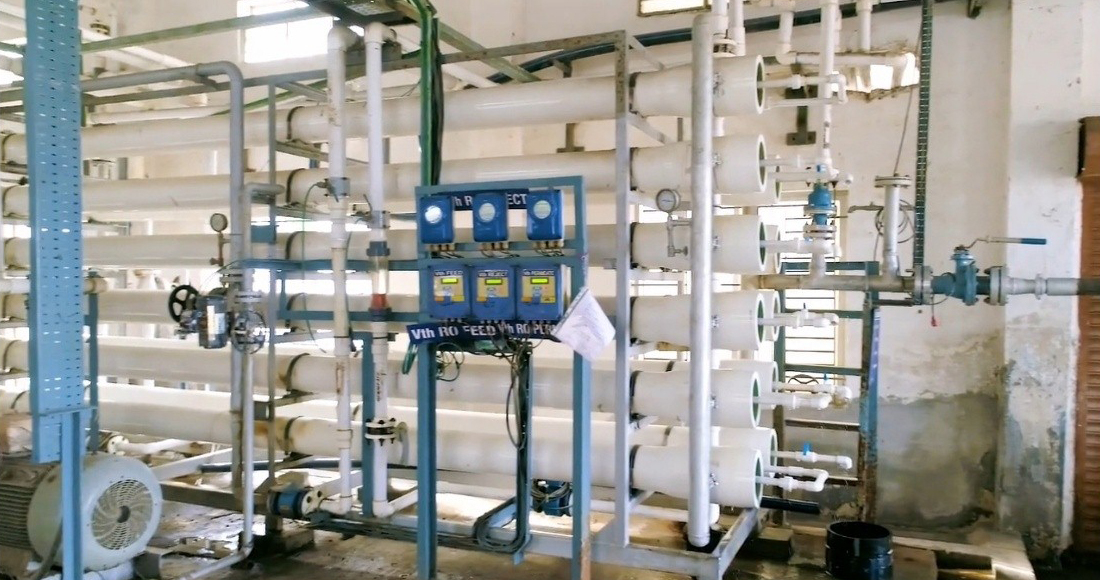
Reverse osmosis system is the process opposite to the osmosis, where the solution from higher concentration to lower concentration through a semi permeable membrane by external pressure provided by high pressure pumps. The CETP consist of three stage RO system designed by KCETP to get overall recovery of 85% of product water free from dissolved salts. First & second stages are loaded with Brackish Water (BW) membranes and Third stage is loaded with Sea Water (SW) membranes. Hydrochloric acid, Antiscalent and Sodium metabisulfite (SMBS) are the common chemicals used in R.O process. The chemicals are stored safely in the dosing tanks and dosing through the feed line by a metering pumps.
PSF 3rd Stage RO (A,B,C,D Banks) 4th Stage RO UF - II Sodium Sulphate Stream Chloride Stream Nano Filtration UF – III 5th & 6th Stage RO

The permeate from the R.O collected in Recovered product water storage tank (RPWST) and distributed to the member units. Online flow meter is installed in recovered water line to measure the quantity. Reject water from the R.O - 3 stages system stored in reject water storage tank and fed to RO 4th stage followed by RO 5th and 6th stage to increase the concentration of the reject and fraction of reject from RO 5TH AND 6THtaken for the Brine preparation and balance will be fed to the Multiple Effect Evaporator (MEE).

The R.O system is often required for flushing and chemical cleaning called as CIP (Cleaning in Process or Cleaning in Place). The membrane cleaning is carried out by passing different chemicals such as acetic acid, EDTA, Sodium Hydroxide and biocides. The addition of chemicals are the based on the requirement of cleaning process and type of fouling. The wastewater after chemical cleaning and flushing process will be fed to the SHT.

  • 2. Additional Stage RO System - (4th Stage RO)
    Additional stage RO system is provided to further concentrate the reject from RO -3 stages. The reject from 3 stages RO will be fed in to this system at a TDS of around 40000 mg/l. The Reject TDS would be of around 62000 mg/L. This system is designed for 35 to 40% recovery.
  • 3. RO 5th & 6th Stage
    RO 5th & 6th stage system is provided to reduce the load to MEE and generation of Brine solution. The reject from RO 4th will be fed in to this system at a TDS of 62000 mg/l. The Reject TDS would be of around 115,000 mg/L. This reject is further treated and dispatched as brine solution to reuse at member units. This system is designed for 45 to 50% recovery.
    Almost 93 % of effluent has been recovered as reusable water from Phase - II, the same recovered water is dispatched to member units (Dyeing Units) through pipe line conveyance system for their industrial process utilisation.
    Hence Industries connected to our Kasipalayam CETP doesn't require any outsource make up water for their production
  • 4. Chloride & sulphate separation - Nano-filtration
    This Nano Filtration has been dedicatedly installed at the inlet of Brine Treatment and Thermal Evaporation systems for separating Chloride and Sulphate Salts
    • System Capacity - 500 KLD (200 KLD + 300 KLD - parallel operation)
    • Make of Membrane - Veolia & Hydranautics
    • Qty of Membrane - 15 + 10 = 25 nos with 37 m2 surface area / membrane

    Overview:

    Nano Filtration (NF) is a pressure-driven membrane filtration process positioned between Ultra Filtration (UF) and Reverse Osmosis (RO) in terms of separation capability.

    • Membrane pore size: 1-10 nanometers.
    • Removes: Larger molecules, divalent ions (e.g., calcium, magnesium, sulphates), some organic compounds, and colour.
    • Allows: Most monovalent ions (e.g., sodium, chloride) to pass through.
    • Applications: Colour removal, sulphate separation, and partial desalination.
    Nano-filtration

    For 4.4 MLD CETP at 100% capacity, the product from UF-III is ~300 KLD @ 120 g/L TDS, with turbidity less than 1 NTU.

    This UF-treated effluent is fed into the NF system for selective separation:

    NF Permeate: Sodium Chloride (NaCl) solution (~30-40 gpl), low color and organics.

    NF Reject: Sodium Sulphate (Na₂SO₄) solution @ 140 gpl